something human

Written by Emerson Enriquez 170819

“I wish I could say something sympathetic, something human”

Trainspotting (1996)

Trainspotting was a movie I needed to see. If I’m going to be honest and sentimental and all, I wasn’t in the best emotional or mental state when we viewed it in class. Let’s just say I wasn’t fully in tune myself. At the time, I needed that “hit” Tommy was talking about when he described what taking heroin was like.

The first part of the film shows Mark Renton visibly undertaking (or rather attempting) a journey to sobriety from heroin. It starts off a little “shitty” (yes, attempt at humor intended) and arguably, it really did go downhill from there. He, along with his “mates” Sick Boy, Spud, Tommy and Begbie form a Moron 5 who each go through a relapse back into the drug, with all of them having to come face to face with their bad habits. Traversing through the wonders and plights of sex, relationships and coming into terms with themselves, the use of drugs for a “hit” becomes a way for them to cope with it all. As temporary as the sensation can be, it’s good enough to suffice for them.

What really got to me was when Mark’s parents confined him in his bedroom after he overdosed. All the hallucinations he had haunting him, with cold sweat running down his spine was a chilling montage. It made me realize how beyond the thrill of heroin, Mark was really just a lonely person looking to detach from that solidarity. He was trying feel as “human” as possible.

I guess in a way, I also look for ways to feel as humanly-human as well. There are bad habits I frequently revisit that fog up my mind, making it unclear for me what I really want out of life. I’m also adamantly hunting for the ultimate hits in my life, the ones “better than sex”, the ones that make me feel the most young and human, I guess. The truth is, perhaps I’m searching them because I’m immensely scared that I won’t be able to make the most out of the time I have. Renton and I both want instant gratification that dissipates, but as long as it’s there, we’re all for it.

When the Moron 4, deducted by one due to Tommy’s AIDS-caused death, reunites after Spud serves his shoplifting sentence, they go on a heist-like expedition to make some cash to, once again, get that “hit”.Mark decides to make a run for it with the money, leaving Spud his well-deserved share. The 90 minute black comedy ends with Renton walking off with 12, 000, exclaiming to himself how he’s going to have a perfect white picket fence life from then on. Whether this was what was ideal for him, or if it was what he thought was ideal for him, is up to question. I guess in some way though, this exhibits the true and seemingly, final withdrawal from the drug for Mark.

Admittedly, watching the entirety of the film didn’t leave me as optimistic as Mark was at the end when he got away with his loot. Leaving the classroom that day, I plugged in my earphones, listened to my R&B, tucked my hands in my pant pockets and just walked around campus aimlessly. There was so much melancholy going on inside of me after seeing the movie. If anything, it made me realize how sad and lonely I actually am, and maybe that’s a “good” thing for something like Trainspotting. It helped me realize my desolation as a human being, who’s probably going to be “happy” again soon, and later on, will be back to feeling all the gloom. Although, I guess that’s the humanity behind it all – how our emotions can be temporary, but more importantly, how (painfully) real they can feel.

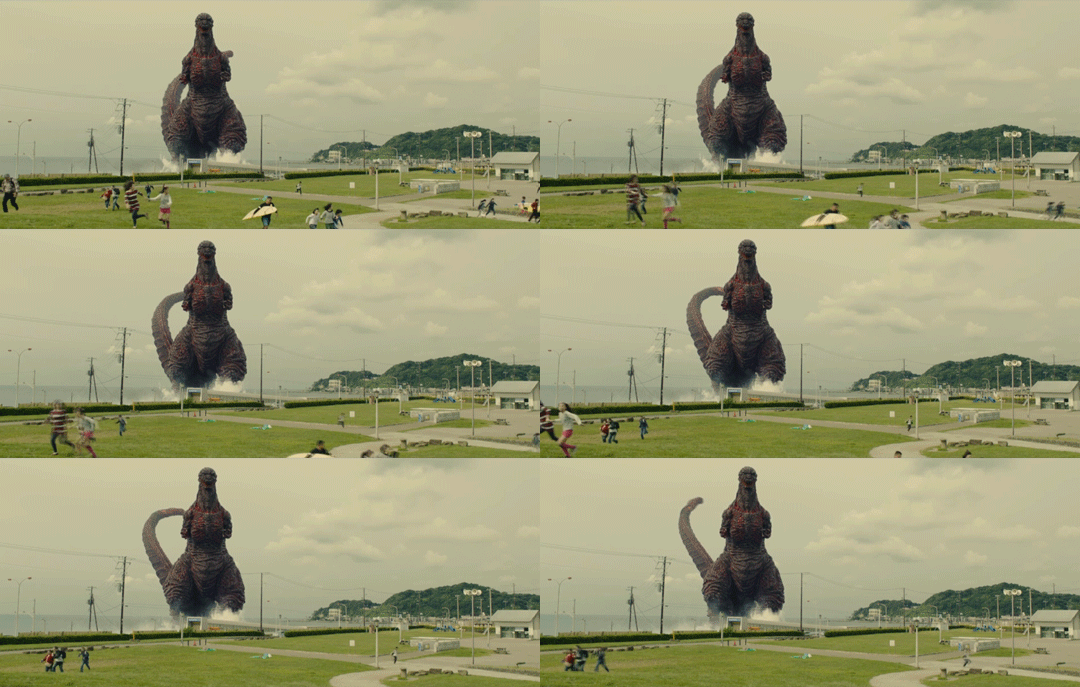
How a bunch of nerds saved Japan from the terror of Godzilla

Written by Emerson Enriquez 170819

In the least offensive way of meaning it, Godzilla is a nerd movie. More than being centered around fantastical themes or monsters, a “nerd movie”, for me, is the type of film that has that cult following through the years, the type’s that referenced in any other media or in plain daily conversations. Nerd movies are ones that keep you coming back to cinemas whenever there’s a new release – cause they’re just that established and powerful – and the 2016 Japanese rendition of the Godzilla is no exception.

Monster movies like those from this franchise are legendary, with the namesake skyscraper-tall reptilian monster that tears through cities being an icon through generations. Personally, I don’t usually find myself veering towards movies centered around fantastical themes. As much as the 2016 Shin Godzilla  is quite obviously centered around the beast, what I found more compelling in the whole 90 minutes or so were the charm, diligence and ingenuity of the actual humans portrayed on screen. The movie itself isn’t just categorized as a nerd movie, it’s somehow about nerds themselves.

The film jump-starts with the conflict front and center, some commotion being caused on the coast of a Japanese province. After quite foolishly assuming that whatever was causing such a disruption wouldn’t be able to make it to land, the local government eats its words as the gargantuan creature tears through a Japanese city, leaving several civilians harmed and scattered. This is the first and most notable instance in the film where one can observe the uniquely human trait of critical thinking and decision making. Counseling the Prime Minister, and influencing his every command, are a party of people who each look into a specific aspect through their courses of action. The main discussion is how to halt, and eventually, how to obliterate the monster.

Unsatisfied with the rather haphazard approaches by the immediate cabinet of the Prime Minister, Cabinet Secretary Yaguchi forms a task force of his own scientists who present themselves to be more than interested in the beast. The team is composed of people who would conventionally be what “nerds” look like honestly. Scruffy hair, lab coats, goggles over glasses – the works. They’re able to procure valuable information about the monster, like its ability to reproduce asexually, and how its blood works as a cooling system for the body, so as to avoid overheating while on land. Having known these, they get to formulating a strategy that makes the demon meet its demise – with no need for any nuclear collateral damage.

Aside from this team of local assets, a government diva in the form of Ms. Kayoko-Anne Patterson enters the scene and adds a whole lot of sass, and a considerable amount of charm that the film not necessarily lacked, but needed some way. To the plot, she added that painfully cliche but relentlessly cutesy addition of a “love interest” with Secretary Yaguchi. Technically, she was a huge contributor to the demise of the monster, unraveling professor Moro Gaki’s earlier rejected presumptions on the existence of the god among men. In the end, what the film managed to showcase to me was not necessarily how the rapidly evolving creature tore through a city, but more on how the human hand is present in all aspects when it comes to managing disasters.

Governments of different countries utilize different ways in handling calamities of all kinds. In Shin Godzilla, it was capitalized on how in any destructive situation, there is more than one pair of hands and more than one brain at work. Human capabilities are shown to be more expansive when they are combined and used in unison. The nerds saved the day in Godzilla, and not all of them we’re in lab coats or donned boxy glasses.

Train Spot

Trainspotting is a movie about Mark Renton, a heroine addict in Edinburgh with four friends who’s nicknames were Sickboy, Begbie, Tommy and Spud. For the most part of the film, I personally felt sort of “high” in a sense that the scenes that were depicted were somewhat crazy and stupid that I felt like I was in the situation Renton was in. The scene with the worst toilet ever was the scene that started the “high” feeling for me. Renton being no longer constipated defecated in an extremely dirty toilet and shoved his hand in it to get a white pill which was handed to him. He eventually falls in the toilet and at that time, seemed like he was swimming in an open ocean. I admit that I looked away for most part of the scene since I literally felt nauseous seeing that scene.

As the movie went along, Renton was brought to the hospital by a taxi driver because of overdose of heroine. It was at this moment where I felt the “high” feeling I felt throughout the movie. Renton was brought home and was isolated in his room by his parents to force him into withdrawal which started to make him go crazy. In my opinion, the fast soundtrack that was playing in the background matched what Renton was going through at that time since he wanted heroine but the absence of the drug made him go crazy. He began to scream and have visions of different things which lasted for I think over 5 minutes. I had to look away for awhile since staring at the long scene sort of made me dizzy. I never felt a hangover in my life but I felt like that scene gave me a glimpse of what a hangover feels like since a drug addict goes crazy without it and an alcoholic has bad headaches and vomits at least that is how I would describe what I was feeling at that moment.

After that long scene, Renton eventually moves to London and seems like he has given up on heroine and has his life straightened out. However, Begbie comes back and influences Renton to go back to his old ways. They both return to Edinburgh because of Tommy’s death. Shortly after, Sickboy, Begbie and Spud reunite with Renton and force him to try out a new heroine’s purity. They eventually earn £ 16,000 which they split it amongst the four of them (£4,000 each). They celebrate in a pub but Begbie causes a fight and the following day Renton steals the £16,000 but leaves £4,000 for spud since he felt bad for him.

It was after the long withdrawal scene that I felt “normal” again since I believe the movie did a great job putting the audience in Renton’s shoes. In the end, I felt happy for Renton since he was able to move on from the negative influences surrounding his life. Even if he did betray Begbie, his other two friends Sickboy and Spud also left him which made to believe that they all moved on from a negative force that kept bringing them down.

Shin Gojira (2016) – Film as a Visual Form of Appeal

There were two regrets that I have as I was becoming a film enthusiast. One was to be nit picky with even the smallest of details. It did not matter that any flaw could be tolerated or obscured; it just should not be there. Another was to have this subtle bias against the mainstream cinema because of how a lot of them were “passable”. Those movies were neither bad nor good per se; they were just what they give you, and bluntly, I hated that certain aspect because such films could have been so much more.

Unfortunately, this picky personality of mine hindered me from enjoying the films just for the sake of it. Since then, I tried my best to rekindle that carefree fun, and one of those that I liked even when they are not on the “masterpiece” level is Shin Gojira (2016).

Objectively speaking, it is not perfect, but it is still quite thrilling for most viewers to the point where the flaws could just be brushed off. It begs the question, though; how does it make it enjoyable to most? This inquiry is especially interesting, considering that Godzilla is a near ubiquitous icon in pop culture that has existed for decades. Typically, people will get uninterested in something old and repetitive, yet Godzilla’s jaw-dropping and destructive rampage has appealed generations of moviegoers that it is now considered a timeless modern classic.

(A lot could be discussed on the socio-political and nationalistic portrayal of the human characters with regards to their reaction to such calamities, but this reflection would like to focus on Godzilla itself.)

So, how did this 21st century remake get the job done? The answers were surprisingly simple: through its character design and a creative mise-en-scene. Ironically, audiences adored Godzilla because of how vicious this gigantic kaiju is when placed on a densely populated human civilization. Visually speaking, its gargantuan size in comparison to the city and its inhabitants justified this, but this is not enough to make him look menacing.

For the case of Shin Gojira, another quality of the filmmakers’ adaptation of the monster is its unpredictable metamorphosis.

In the beginning, the initial stages of Godzilla looked premature; its gills were openly wounded, it had no arms and it had bulging fish-like eyes.

As the film progressed, it started to grew in size and was able to stand on its two feet…

And finally, it reaches an ultimate stage of emitting radioactive breath.

This characteristic of Godzilla worked so well because this already frightening kaiju is made even more terrifying with each evolution worse than the last, and it leaves a convincing impression to the viewer that it is indeed indestructible, as the human characters suggest. At the same time, the film engages the audiences into seeing not only how Godzilla will destroy but also what will happen to him next.

To conclude, this is exactly the quality of film that I wish to rekindle. While I do appreciate the famed cinematic achievements that were able to offer some deep & profound themes as well as enigmatic narrative techniques, I always remembered that movies can still be made enjoyable through a show-and-tell style the way Shin Gojira did so. Afterall, it is one of cinema’s first and foremost, albeit unwritten, rules: to make it interesting or appealing.

With regards,

JoMar Fernandez a.k.a JMCthefilmystan

Images used:

Gojira!

I was never really a fan of the Godzilla movies or movies of the same genre altogether. But this one, this one I somehow-maybe-quite likely- enjoyed…
I don’t know, I just cant seem to outrightly take delight in watching something destroy everything in its path and get destroyed itself (sorry, I know it’s more than that 😦 ). Maybe I’ve only watched these kinds of movies when my mood doesn’t fit it’s theme, or maybe its really just not my thing.

But nonetheless, some of the funny dialogue and the creative storytelling paired with the fast-paced editing of the movie hooked me enough to the point that I was excited to know how they’ll resolve the threat of the all-powerful mutant bird-whale-dinosaur-monster/ insurance company mortal enemy that Godzilla is.

Prior to watching this, I’ve never watched a Godzilla movie completely. The only times I’ve seen parts of it was when it was on HBO or StarMovies back when I was in grade school. Saying so, I was familiar with what Godzilla is, because who isn’t, even though I’ve never fully watched one of it’s many movies.

First thing that comes to mind about the movie is that the first sight of Godzilla was quite underwhelming. It was like one of those frozen foods sold in the grocery wherein the displayed item in the packaging is significantly alien to whats actually inside. I was expecting Godzilla, the great, big, scary, monster who’s the bane of concrete and glass. Instead, I got a giant armless rubber chicken flopping through the city’s canals. Ooh. Scary.

Although come to think of it, I would probably be terrified to the bones if I see something like that in real life.

Of course we eventually all saw that Godzilla then evolved into the gruesomely beautiful big chunk of reptile-looking piece of meat that we all know him (?) to be. And he did this in such a weirdly comedic yet intimidating fashion, disappearing then coming back to the scene each time with a different feature at hand. May it be it’s skin, it’s size, it’s power, or even it’s eyes. It’s as if Godzilla merely went onto the land to farm some buildings so that it may then go back into the water to buy some upgraded gear, then return and farm some more buildings to upgrade once again.

It was also refreshing and interesting to see how the characters dealt with the situation that laid before them. The situation being the monster, the destruction, and the coming of up the solution to the problem. I liked how everyone had and knew their roles and they sticked with it. No one seemed to be above or below the assigned position they were in and it was in this dynamic that the movie also squeezed in a sequence of nice jokes that I may or may not have understood.

I believe it’s also a representation of how the Japanese people deal with similar things in their country, as the process was very orderly and respectful. In fact I wouldn’t be surprised if that’s how they’ll handle a real Godzilla attack. (lol)

Although this definitely wasn’t my favorite movie, I found it good enough that I would probably tell my friends to watch it if ever they are craving for some destruction and Japanese wit.
Though I doubt that they’ll ever ask me for a movie with that description, at least now I’ll have an answer if it somehow happens.

Shin Godzilla

Shin Godzilla was a movie that turned out to be much different from what I had expected. When I saw the movie titled Godzilla on the course schedule on our class syllabus, I was excited and prepared myself for an action packed film where giant monsters destroyed cities and fought each other. To my surprise, this film adaptation of Godzilla was not as action packed, but still remained interesting in other ways.

Before watching Shin Godzilla in class, the most recent Godzilla film I had watched was the one that starred Bryan Cranston who played Walter White in the popular series Breaking Bad. The film was shown back in 2014 and depicted giant monsters apart from Godzilla as the villains and the ones causing destruction and havoc on humanity. These monsters are then taken care of and defeated by Godzilla later on in the film, which made it seem like he was a saviour to humanity.

On the contrary, the portrayal of Godzilla in the Shin Godzilla film adaptation was more negative as Godzilla was seen as a monster that wreaked havoc on Japan, causing massive amounts of damage to the countries infrastructure and inhabitants. The Japanese portrayal of Godzilla was more akin to a natural disaster like an earthquake or a typhoon, which is very different from how the Americanized Godzilla was portrayed.

In addition to this, Shin Godzilla seems to focus on how the Japanese government responds to an unexpected disaster. I also found it funny how the film poked fun at the formality of the Japanese government and how this formality could be seen as unnecessary and even inefficient at times, as shown in the movie. It was also interesting to me that Japan made fun of their government and its inefficiencies because knowing the history of Japan, I would like to think that their government would be seen as very competent because of how they were able to bounce back from the destruction and costs World War 2 had upon them.

Also, upon further research, the original Godzilla film apparently portrayed Godzilla as an expression of the destruction caused by the atomic bombs dropped on Hiroshima and Nagasaki while Godzilla in Shin Godzilla was supposed to represent the nuclear disaster that occurred due to an earthquake and tsunami back in 2011. You can see that in how Godzilla in the film was spreading radioactive energies in its wake similar to how radioactive energies were being spread during the nuclear disaster that happened back in 2011.

In a sense, we can see in the differences of the Americanized Godzilla film vs. Shin Godzilla the difference in what the audience of each respective country would enjoy in a movie. This is reflected in how Shin Godzilla was deemed very critically acclaimed in Japan, but was not seen as that much of a masterpiece elsewhere in the world. It could also be the fact that the Japanese found the expression of Godzilla and how he represented the disaster that occurred in their country, as well as their jokes regarding their own government much more relatable and interesting compared to how foreigners or outsiders who don’t have the same shared experience won’t necessarily understand or enjoy it as much.

On that note, Shin Godzilla definitely opened my eyes on how and what Godzilla was intended to represent compared to the Godzilla that I was exposed to in pop culture that caused destruction but was also somewhat of a hero to humankind by defeating other monsters that were destroying cities on Earth. I personally enjoyed the Americanized version of Godzilla, where it was more about a monsters fighting each other and had more special effects and action. However, I can see how and why people would enjoy Shin Godzilla, especially if they understood the context of what Godzilla was supposed to represent.

Surpassing expectations: On Shin Godzilla (2016)

Shin Godzilla was the first Godzilla movie I’ve ever seen. I didn’t really have any expectations for my first Godzilla experience, and I didn’t really know what a typical Godzilla movie tackled. You could say I had more questions than expectations—Does the whole movie center on a random monster that comes to wreak havoc on a random metropolitan area? Do we just follow the city’s government thinking of different ways to take the monster down? Does the movie just end with the monster dying? Is that really all there is to Godzilla movies?

(To answer my last question: Shin Godzilla was more than just that.)

The first thing that struck me about Shin Godzilla was the film’s incredible production value. As a former COM124 student, I’ve had my fair share of frustrating moments with camera movements and cinematography. There were so many scenes where the camera moved so swiftly and smoothly, and scenes that were so cleanly shot in one go, with no cuts whatsoever. Scenes where different characters were passing the laptop to one another were also very well-coordinated, and I’m sure perfecting these scenes took a lot of practice and rigor.

Apart from the film’s cinematography, the film’s CGI was seamless, and felt incredibly lifelike. Godzilla’s powers and transformations shown throughout the film made me jump in my own seat, even if I knew in the back of my head that none of this was real. It was clear the film’s producers invested a lot of money into special effects, in order to make the film as realistic as possible. Films like this usually leave me thinking about all the creative work the filmmakers did for all the graphics, but Shin Godzilla made me suspend my disbelief immediately, without even thinking about it.

The second thing I grew to appreciate about Shin Godzilla was its worldbuilding. I’m also absolutely in love with everything about Japan, and I can confidently say it’s my number one happy place, after having visited Tokyo and Osaka. Shin Godzilla managed to preserve Tokyo’s cultural identity while successfully intertwining it with the fictional components behind Godzilla, and the city’s different strategies to exterminate the monster. They managed to include scenes of Tokyo’s busy streets and subways, while adding a little science fiction twist to them.

Additionally, I will admit that, because I had very few expectations, I underestimated the complexity of the film altogether. I found myself spacing out during the scenes where different government officials and other characters were discussing the science behind all their strategies. Despite not being able to understand the finer, confusing details, I was able to appreciate how well-thought-out the story was. Each of the government’s battle plans were backed up by empirical data and research, and the writers of the film even managed to insert a little side story on a possible romance sparking between two characters.

I do, however, have a tendency to make wise-guy remarks when watching action films—although I do my best to stop myself—because they tend to be very unrealistic. I generally approach the whole “disaster movie” with a sarcastic attitude, because the protagonists claim to have “saved the city” from a certain threat by inflicting more property damage than the actual threat would if it were never eradicated. However, with all the technical and creative storytelling elements in Shin Godzilla, it was easy for me to set my skepticism aside for entertainment’s sake—and I was not disappointed.

Overall, Shin Godzilla served as a great gateway to the vast world of Godzilla movies. In spite of all my apprehensions, I’m more than willing to give other Godzilla films a shot.

A dose of (unexpected) reality

First, a disclaimer: I have never watched a Godzilla film before this screening. I have heard of the franchise, but I was rarely drawn to monster movies enough to seek it out and pay to watch one in the cinemas. With this, I was intrigued by the prospect of watching a film that featured a monstrous dinosaur-like figure rampaging across a first-world country.

The first act of the film surprised me: it was a realistic depiction of an unrealistic or unlikely phenomenon. What would any government do when faced with the unprecedented appearance of a larger-than-life- beast? Of course, stick to what is known, which is the protocol. Unfortunately, a sudden monster attack is not the best event to realize that bureaucracy and red tape in a time of crisis will contribute even more chaos and casualties to the threat itself.

This was a welcome and poignant insight for me, and one that I did not expect from a monster blockbuster. It also prefaced how Shin Godzilla would eventually progress throughout the film: not through willing heroes that would jump to death to save everyone’s lives, but through rational collaboration and teamwork that does not necessarily rely on protocol.

As much as I liked this premise, I must admit that its overall impact was perhaps unintentionally decreased by some visual effects that left me and the rest of my fellow viewers chuckling instead of trembling in fear. The first phase of Godzilla looked like a glorified version of Toothless from How to Train Your Dragon, and therefore, made me less inclined to perceive it as a monster in favor of seeing it as a clumsy dragon that doesn’t know better.

Although, as Godzilla phased further, I liked the development that the remaining characters portrayed owing to their adaptation to the predicament. There is rarely a case for individualism here, but is justified in the event it is revealed.

Overall, I liked my first Godzilla experience. It was grounded on reality even in the temptation of going overboard with its premise, and showed a surprising level of humanity and nationalism, much more than I would expect from any monster film.

When tension elevates nonsense

As the introductory film to Elements of Screen Arts, Schizopolis floored me for a number of reasons, making me label it as a thoroughly entertaining watch. Its lack of an implicit plot pushes the viewer to look at the individual aspects that make up the film, and these features are unconventional enough that one can recognize them off the bat and make judgments based on their effect.

That being said, I found the entirety of the film incredibly weird and hilarious, and I loved every second of it. At the onset, I looked at it as a commentary on corporate and married life, and I thought it made several points. Apart from this, though, the film also made a whole lot of nonsense appealing, which is unconventional in my personal trajectory of film-watching.

I found that the film’s characters – a corporate employee, his adulterous wife, his insecure coworker, and his alternate self, among others – can shift from being understandable and relatable at one moment to being completely absurd at the next. This was a dynamic I was not prepared for but genuinely liked, as I was forced to look at their nuanced characteristics instead of trying to make sense of the nonsense they were projecting.

Schizopolis’s worldbuilding worked well for me in relation to its other elements, in that its mundane setting further accentuated the weirdness that was happening throughout the film. The depiction of these characters moving through their pedestrian circumstances was playful and unique, and this mismatch was what the film had going for it.

The film’s dialogue worked in a similar fashion, in that some sections were truly incomprehensible, but allowed me to look at the tone and emotion that they attempt to convey or evoke. In this regard, I felt the emotions in a new kind of way. This technique unexpectedly made the emotions more potent.

Apart from the film’s technical merit, it also evoked in me a certain cognitive dissonance. I have dedicated my life to storytelling and the impact of words, but this film showed me that language can mean nothing and still convey something! In truth, that made me uncomfortable, but I cannot discount its reality.

This unique approach to filmmaking kept me hooked for the entire time, its richness in absurdity making me want to know what will happen next. For some viewers, this method might seem standoffish, but I liked it for how it deliberately throws all conventions out of the window in trying to depict conventional realities. This tension reveals the film’s charm and genius.

“I had to keep the world satisfied”

Rando Yaguchi somewhat ends the movie with this line. While it might refer to his leadership and actions that lead to Japan’s salvation, I thought that the line also captured what the movie needed to do. The Godzilla franchise has been around for so long that new generations, including my own, have lost track of what or who Godzilla really is. I was introduced to Godzilla through the American remake/reimagining back in 1998 but I was also aware that various films or media have portrayed Godzilla as a protector rather than a destroyer, which is probably how the much newer generations see him after that recent 2014 Godzilla movie.

Before I delve deeper into what I think about the quote of Rando Yaguchi, I found myself interested in the original 1954 Godzilla movie since I saw articles that were written before the Shin Godzilla movie came out saying that this new Godzilla movie would be more accurate to the original. I thought to myself that maybe Shin Godzilla is the exact same as the old one in terms of the plot, but it appears there are many differences, especially with the context of the film. I watched “Godzilla 1954 Retrospective // DC Classics” from Dark Corners Reviews in YouTube to give me a brief account of what the original Godzilla movie was about. Indeed there were similarities with Shin Godzilla, but the context of the 1954 movie being closer to the atomic bombings in Japan versus the more current context of this 2016 movie became the most apparent. Because of the original film’s closeness to the bombings in terms of time and memory, the film came out more horrifying than it should have been. This horrifying aspect also makes the original much more different from the newer Godzilla films since the sequels, remakes, reboots, etc. were made to entertain more than to horrify as seen with the more action-filled or even comedic scenes. Shin Godzilla on the other hand does not fall under the same direction as these reboots, etc. but it still remains to be an entertaining film with a right amount of action and destruction that can leave viewers horrified.

From a personal perspective, many people and media in my life have always referred to the Japanese government as an organized group that was efficient and excellent; while I can’t be 100% sure of how efficient they really are because I don’t fall under their government, many viral posts about how they can fix destroyed roads or respond to natural disasters quickly and effectively have made that perception of them more believable. With this in mind, seeing this government in turmoil because of Godzilla made the film more horrifying. The focus on the government seemed to be a good option for storytelling as well, since the government would supposedly be the first to gain information regarding the mysterious Godzilla and the audience could also better see the widescale devastation caused by Godzilla. We also get a glimpse of how the government has a difficult time satisfying everyone, as seen with the less aggressive actions against the smaller Godzilla to protect civilians or the highly aggressive actions against the larger Godzilla despite the collateral damage. Through the government perspective of the film, we also feel more horrified of Godzilla given that this supposedly efficient and excellent government could not respond properly to the threat, again showing the difficulty of satisfying both the Japanese people and the world [in the context of the movie’s world].

satisfied“I had to keep the world satisfied.”

This line, for me, does not only show Rando Yaguchi’s political moves, but also the film’s stand in this day and age. More and more films are becoming [arguably] mindless action movies that focus on visuals and effects, and perhaps it is so because there really is demand for such movies. Though on the other hand, there is also demand for more “human” movies that touch on plot, characters, relationships, etc. more. The first Godzilla movie, based on what I saw from Dark Corners Reviews in YouTube, seems to have captured both aspects by being a visually stunning film [for its time] and showing how the Japanese people reacted to the destruction. In today’s time, achieving both of these aspects have been difficult for many blockbuster movies, but Shin Godzilla gets past this obstacle and proves it is more than just a big dinosaur-like creature destroying Japan. It does its best to indeed keep the world satisfied; it provides a visual experience for the more action-focused audience but it also shows human interaction and plot for the more human-focused audience, and as a bonus it also shows a more faithful-to-the-classic Godzilla for the original’s fans!