
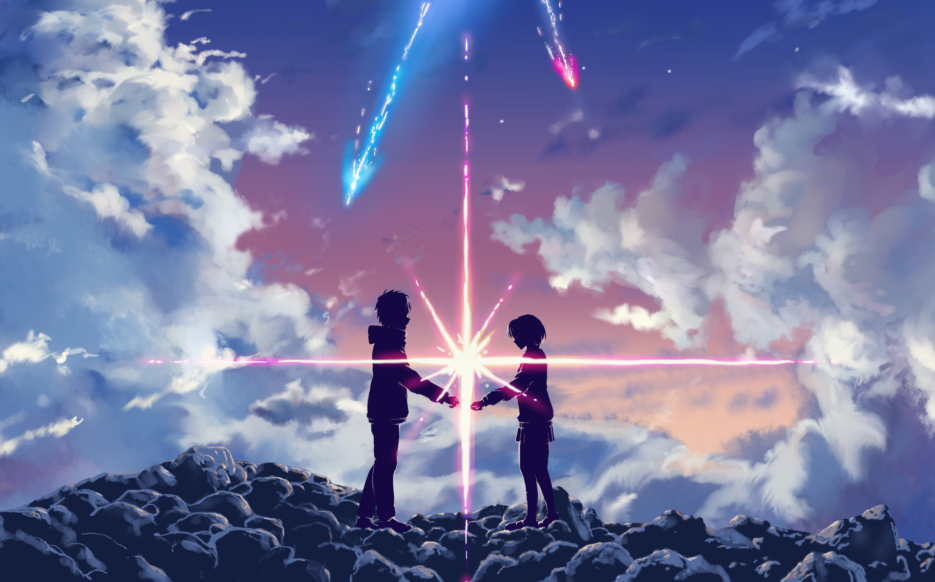
It was my first time to watch this film and I knew just from the first scene that it would not disappoint. I was immediately captured into the world of Shinkai Makoto’s beautifully crafted animations which showcased detailed images from many angles and perspectives and colourful aesthetics as well. Since the film was partly set in Tokyo, I couldn’t help but reminisce the last time I went to Tokyo and walked the same streets Mitsuha and Taki walked on. Aside from the scenery, the way the characters were designed shows how they weren’t overly detailed but yet, each character was distinctive. Overall, the animation largely contributed to bringing light to the story of the film.
The film did an excellent job in evoking the emotions of its audience through the characters of Taki and Mitsuha. Their relationship could somehow be compared to that of a long distance one but more unconventional with the body switching kind of plot. As the film progresses, the audience gets to see the development of the characters especially, Mitsuha and Taki and how they forge that intangible connection after getting used to being in each others bodies. They both fall in love without realizing it — their innocence making the film all the more heartwarming. Through the notes they made for one another, it just shows how they were trying to make the other appreciate life more and try to help improve the others’ life in some way. One of my favorite scenes was when Taki, upon visiting Itomori, discovered that the Mitsuho he swapped bodies with was from three years in the past. It is from this scene onwards that everything begins to unfold. Earlier on in the film, Mitsuha’s grandmother talks about the concept of musubi and how everything they do is musubi — from tying thread to connecting people. It is a connection moving between people and objects in the world. But the film explored the concept of musubi in a deeper level, far more complex than concrete connections like the tying of Mistuha’s red string. Her red string symbolizes her relationship with Taki that despite the fact that they live in different time periods have different circumstances, they are still binded by that long red string — the red string of fate.
To describe the film as a masterpiece still wouldn’t do it justice. It takes the audience on an emotionally engaging journey that is Mitsuho and Taki’s life and shows how two lovers can transcend time and space just to be with each other. The line “I feel like I’m always searching for something, someone.” which starts off the film tugs at our emotions since there are times when we too feel a sense of displacement in our lives that leaves us searching for something or someone. Aside from this, Makoto’s use of trains as a metaphor gives the idea of a hopeless and distant love. Just as how trains arrive and leave the station, Mitsuha and Taki’s love was fleeting too. The film ends with the two characters uttering the words “Your name is…” which gives the audience that assurance that everything worked out in the end while leaving it to their interpretation on what could happen next in Mitsuha and Taki’s future.




 Elements of Screen Arts (2019)