
In a world where white supremacy has been put into great scrutiny and question, and where literally everyone around the world is fighting for equality, films like Sorry to Bother You become very relevant. An American science-fiction dark comedy that blends conventional comedy with political satire, Sorry to Bother you is about a struggling black man named Cash and how he has to conform to the standards of a white society — to the point where he is forced to use a “white voice” in order to excel in his job. The film is delivered in a light, hysterical, and comical manner, and can be argued to be one of the funniest movies of the year. The goal of the movie is to entertain, but deep within this intention is the satirize the ridiculousness of white supremacy in today’s society. Behind the laughter that the film gives to its audience is the horrific truth of how corporate slavery is advertised as something good for everyone, and that it is important to conform to white standards in order to somehow blend in and make a living. It highlights the issue of inequality among races, and the manner in which this trope is portrayed in the film is quite accurate to how things are in real life for many people. However, if you want to sit down and just have a good laugh at this ridiculousness, then you can go right ahead and enjoy this movie, too, without having to carry the burden of heavy political and sociocultural issues.
Category: Uncategorized
My Own Private Idaho (Gus Van Sant, 1991)
Movies about life hustlers are always interesting, especially with the dynamic of two guy best friends. With them journeying through life together and figuring out their relationship and identities, it makes me think of them as the ‘growing up’ urban versions of Jack and Ennis from Brokeback Mountain. I guess we could view this film as part of a new wave of gay cinema, opening the genre to more character vulnerability and harrowing stories to tell. My Own Private Idaho is considered a significant milestone in the Queer Film movement, and has grown immense popularity especially among queer audiences. The film can be commended for tackling such a taboo (back then) subject in normalizing it in today’s society. While the central protagonists in the movie are prostitutes, the movie surprisingly is not just about sex. What Mike and Scott, movie protagonists, truly want is to be loved and accepted. These characters were scarred and damaged as children to the fact that being queer was not acceptable. However, the film does a tremendous job in introducing the queer genre into modern Hollywood films. The movie itself is invigorating written with such insight which audiences will surely enjoy. The true victory of this film, however is that it is capable of evoking a certain response from audiences and forces people to go beyond their comfort zone by embracing the taboo.
Futureless Things (Kim Kyung-Mook, 2014)
Honestly. So. Lost.
This Korean drama will have you saying (pardon my french). WTF, at just about every scene. It was another eclectic film that does have a deeper meaning (which I get into more later). Other than the weird butt poo happening, I enjoyed the move because of how korean drama films are known to grip and captivate the hearts of their viewers around the world. And Futureless Thing does not drift away from this stereotype at all. This film tackles the current state of modern urban living in South Korea as it is set almost entirely in a convenience store and zooming in on the shifts the workers cover each day. Convenience stores are such a staple in South Korea which makes it even more relatable to the audience. The film does a great job in balancing between the typical art house flick and a relaxing comical movie whose sole goal is to entertain. The humor in this movie is one of its highlights, as it shows the idiosyncrasies in Korean culture. What makes this comedy just something out of this world, though, isn’t just the many different characters and the different situations each of them get into through how they interact with one another, but most of all the scathin socio-criticism that lies beneath the surface. This makes it so that for one to truly understand the depth of the humor, they would have to be familiar with Korean society in order to get all the references. The movie also utilizes the use of music very well, which allows viewers to be fully immersed in the movie. Overall, Futureless things is more than just a comedy with outstanding humor, but the drama and the problems in Korean society depicted by the film make it a highly impressive move that will stick with any viewer for a very long time.
Shin Godzilla (Hideaki Anno, 2016)
Not to spoil, but this may be the oddest Godzilla movie I have encountered. Let’s start off with Godzilla’s final evolution stage/form. His(?) ability to reproduce asexually, and its giving “birth” through its tail to many small humanoid monsters, with long limbs and dorsal spikes. I mean.. what?
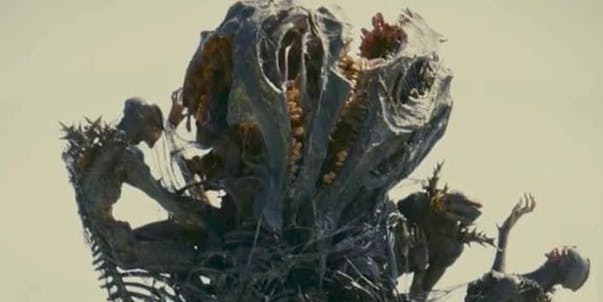
We all know of the gigantic, overpowered and domineering tyrant that goes by the name Godzilla. That name has been around for decades and has risen questions like “what if there is a creature hiding deep with in the ocean, waiting to be awakened?” Say no more, this film will take viewers so close to making this question a reality as Shin Godzilla, the 31st installment in the Godzilla franchise, reimagines Godzilla’s origins deep within modern Japan. Shin Godzilla is an idiosyncratic rendition of the ancient monster and can be interpreted as the ‘New Godzilla’, the ‘True Godzilla’, or the ‘God of Godzillas’. In this film, it is the Japanese military’s first time to encounter such a humongous creature like Godzilla. At this point, Godzilla is so unequivocally powerful and inevitable that the only goal of the movie is damage control. However, though the movie seems to be all about a giant monster constantly evolving and destroying whatever is in sight, there is more to this film than meets the eye. Deep within the roaring reptile is a symbol of divine retribution and the sheer consequences that whatever new crises we, as a human race, will craft ourselves. After the Japan Earthquake in 2011 triggered different nuclear reactors, and after the Japanese government’s subpar response to social crises, one can only expect pissed-off Godzilla to show up anytime soon, ready to wreak havoc and humanity pay for their stupidity. Shin Godzilla delivers all these tropes successfully while cleverly hiding it all at the same time, making it one of those movies that require great attention to detail in order to fully appreciate.
Schizopolis (Steven Soderbergh, 1996)
“In the event that you find certain sequences or ideas confusing, please bear in mind that this is your fault, not ours. You will need to see the picture again and again until you understand everything.” This immediately peaked my interest and made me “tune in” per say. The plot, such as it is, is extremely difficult to summarize but any attempt to do so should give the reader some idea of just what they’re up against, a warning they really should be issued with before sitting down to watch this film.
Schizopolis is one of those eclectic, one of a kind narratives that one would not expect out of a typical movie. Though initially confusing to the average viewer due to its non-linear manner in laying out the movie, its redeeming factor is the fact that it is unique and unparalleled in and of itself. The film tackles the issue of a lack of genuine communication that can be seen in societies consumed by advanced technology. Though the issue at hand is one that is cliche, the film takes this cliche and strips it down to its core, emphasizing its importance and relevance in today’s society. While some movies like horror and thriller films are not for the weak of heart, Schizopolis is not for the weak of mind. One can argue that its truest form can only be appreciated by the sharpest of minds, and that not even the most experienced of cinephiles may be able to appreciate the depth of this film. This film pushes viewers to analyze the different facets and dimensions of the satire, which makes it so that is designed only for those who are open minded. This is a kind of film that would be quite difficult to recreate, just how a meticulous piece of artwork would be hard to recreate. However, once one is able to finally grasp the different ideas, themes, and tropes of this film, this seemingly unappealing movie will be waiting to surprise those who are willing to stick through it all.
#Schizopolis #162210
Fun Film “For F Fake”
F For Fake is an interesting film. It is shot in a similar manner to a documentary, which is usually a type of film that is non-fictitious, and full of facts. In fact, if it weren’t for Sir Ty explicitly telling the class before the viewing that the film is not a documentary, I would’ve assumed it to be one because that was the only thing I felt I could make sense of from the film. However, after reviewing the film and studying it, much like many of the other films that were shown in class, I found an appreciation for its unique style.
I mentioned that the film was shot in a similar manner to a documentary, as it has a narrator who provides commentary on characters that actually existed. In this case, it’s Elmyr de Hory, a renown art forger. After reading up on the history of the film, I found out that this is actually due to the fact that Orson Welles, the director of the film, was originally going to use its footage for an actual documentary on the artist. This is interesting because of how ironic this is. As I mentioned previously, documentaries are meant to be non-fictitious takes on reality, with commentary given by a narrator. Just having a documentary based on forgery is itself ironic, but what accentuates this is that the narrator isn’t even trustworthy himself. Though the film definitely does not take elements from most films, it does use foreshadowing, and it admittedly does this effectively. The first scene is of Orson Welles performing a magic trick on a little boy. He does so wearing a cape, and calls himself a charlatan, which is a fancy word for a “fake”. It’s important to note this because capes serve no real purpose other than to make a character appear more mystical. If you look at common media, people who usually wear capes are superheroes or magicians; characters of fiction or characters that generate the idea of being “larger than life”. In history, people who have worn capes, or at least were thought to have worn capes, are glorified figures like Julius Caesar, who are often portrayed as people who are greater than average humans, or at least they generate that idea, which is of course untrue. Interestingly, he then tells us that for the next hour, everything he says will be true. However, since he called himself an illusionist, how are we, the viewers, supposed to believe that what he said is true? This bears fruit in the final minutes of the play when Welles declares that he lied about the story of Oja, her grandfather, and Picasso. As a viewer, this both regaled and frustrated me because it was actually fun to recall that he basically portrayed himself as an untrustworthy figure in the very first scene of the film and then most of us then trust him without question, which, in a very meta fashion, shows how easy it is to fool people. However it also frustrated me because it made me feel that the whole point of Picasso and Oja’s story was just to show that we shouldn’t have trusted the narrator. The truth is, now that we know that he lied about that one part, it’s hard to believe the rest of the film because we have no assurance whether or not he was lying or telling the truth at some parts.
Digressing, I thoroughly enjoyed having my brain be tickled by the idea that the art forger may not be the real fake in the art world, but the so-called experts themselves. If they are unable to tell the difference between a fake painting and a genuine one, then would it not make them the ones who are faking in the scenario? This was actually quite interesting and I still ponder that question until now.
Overall, I found the film to be very strange because of how its story was told, but I can say, without faking it, that I enjoyed this film.
Lost While Watching “Lost Highway”
Upon my initial viewing, my first thoughts of the film were like the first thoughts that I had for most of the films that were shown in class: “What the heck just happened?” However, upon studying the film further (and by that, I mean reading reviews of the film and watching film analysis videos of it on Youtube) I found that the film is actually quite profound, and, actually a bit like 1999’s The Matrix, really asks the question “Which is better, to live in a harsh reality or a pleasant fantasy?” The things I enjoyed the most about the film are how it asks deep questions without directly addressing those questions.
Though I cannot really talk much about the characters as individuals, I do, however, have a lot to say about the ideas that they represent and their themes. The juxtaposition between Fred and Pete is like night and day. Fred is a normal, some would argue dull or boring character. It feels as though the film has written him to be bland and uninteresting. He’s a white, middle-aged male who lives in the suburbs, so he already feels like the run-of-the-mill guy, which is actually perfect. He is a boring guy that doesn’t really have anything that is too interesting about him. This, however, has an effect on Fred as he believes that he is inadequate for his wife Renee and is unable to sexually please her. This eventually leads to him doing the unexpected by killing her and being sentenced to prison for it. What’s important to note here is that he vehemently denies that he murdered his wife, despite all evidence pointing to him doing so. This is an important plot point because this leads to him imagining the persona of Pete, who embodies Fred’s desire to be interesting to women. Pete, as a character, is far more interesting than Fred. He works a “masculine” job as a mechanic, as opposed to Fred’s life as a saxophonist. Furthermore, he is shown to be able to please women very well, as he has a girlfriend and even has the opportunity to cheat on her with the attractive “Alice Wakefield”, who uncoincidentally is portrayed by the same actress as Renee is. Speaking of Alice and Renee, I found it incredibly pleasing to know that the film basically confirms that they are the same character through the scene showing the investigation of Dick Laurent’s house, where a photograph showing Renee is shown, which is interesting because that same photograph was shown previously to have both Renee and Alice. Renee as a character is just as bland and uninteresting as Fred. Both of these characters, together, represent the blandness that is absolute reality; as these characters feel very flat and generic with nothing about them being “larger than life”. Alice, however, is portrayed as someone incredibly attractive and is even the love interest of a mobster, which make her far more exciting. Together, Alice and Pete are characters that represent fantasy; being something out-of-the-ordinary.
What I really like about the film, though, is when these lines between reality and fantasy are blurred. As Pete suddenly starts to turn back into Fred towards the end, which I feel like is the time in reality where Fred actually has to face the inevitability of his sentenced execution. Even until the end, Fred is running away from the truth, which he previously escaped by imagining the persona of Pete but can no longer do so. When the film ends abruptly, and Fred screams in the darkness, this is what I feel is the point in reality where Fred dies. This was a very interesting choice to make in storytelling because it was hard to understand at first, but after thinking about it, it actually made a lot of sense and made me appreciate the film further.
Though, I am normally not a fan of avant-garde films such as this one, I found Lost Highway to be incredibly interesting after delving into the psyche of its characters.
Kimi no Na wa: A Name I’ll Never Forget
Among the many film names that were found in the syllabus for the class, I was hard pressed to find anything that I had previously watched; that was until I saw 2016’s Kimi no na wa or just “Your Name”. I was immediately excited to rewatch it because it is one of my favorite animated films to date. The film has a unique love story that transcends both space and time, immaculately visualized in Japanese animation, with an amazing soundtrack that blends in perfectly with the scenery while still being catchy and enjoyable enough to be enjoyed on its own. Though I had read analyses of the film on websites such as Rotten Tomatoes and participated in discussions on the film on Reddit, I could never really grasp a complete understanding of the film, so I’m glad that this movie was one of those that we would be discussing in class.
The first thing that I’d like to talk about from this movie is just how weird the plot is. From the very first scene, it follows a non-linear storyline and progresses in a very odd fashion. We start off with our male protagonist, Taki, as he is as confused as the viewers presumably are when he finds himself in a teenage girl’s body. What confused me upon my first viewing was that in the very next scene, we are shown how the girl, who is our female protagonist Mitsuha, would’ve acted on a normal day, which suggests that Mitsuha is living a life a day after Taki took over her body. We are also shown Mitsuha and how she reacts to being in a male’s body. Though body-swapping isn’t exactly a new plot point in media, just look at 2003’s Freaky Friday, this is, what I feel, is one of the few times it is portrayed realistically. Taki, being a teenage boy, would of course be mystified and amused by the phenomenon of having breasts. In the same vein, Mitsuha would also be shocked to find out what having a penis feels like. Though this was portrayed in a rather humorous fashion, it was a realistic yet unique portrayal of the concept. However, what I liked most about this body-swapping is how deeply this lends itself into the development of the relationship between Taki and Mitsuha.
To swap bodies with someone would be taking the saying “Put yourself in another person’s shoes” literally. It is primarily through this way that Taki and Mitsuha build their relationship. Over the course of their interaction, they develop a strong emotional bond with each other as they quite literally live out each other’s lives, learning the struggles of their lives and the people whom they have to deal with on a daily basis. This is made more emotionally gut-wrenching during their last body swap, as Mitsuha scheduled a date for Taki with his long-time crush. However, Mitsuha wakes up from the swap in tears, presumably because she was jealous that Taki was about to go on a date with another woman. Through this sequence, we understand how deeply Mitsuha cared for Taki despite never formally meeting him.
The storytelling is further enhanced by the visuals that the film has. This movie is absolutely gorgeous, and it feels like every single shot of the landscape can be used as one of Microsoft’s stock background photos for Windows. However, the visual storytelling and the symbols in the film are also genius. One example is how part of the meteor breaks off from the main comet and it hits the town. This can be taken literally, but it can also symbolize how there are two realities that existed within the show that were changed through Taki and Mitsuha’s intervention: a “red” reality where the town, and consequently a third of its population, was destroyed by the meteor and a “blue” reality where everyone was evacuated and saved.
Perhaps what I liked most about the film is its soundtrack. Primarily composed by RADWIMPS, a Japanese band, I actually found out through the class’ discussion of the film that the reason the integration of every song felt so seamless and perfect was because they actually tailor-made each song to be used in the film by collaborating with the animators. The soundtrack features amazing songs that fit perfectly with each scene that they’re paired with, like the high energy “Zen Zen Zense” during the body-swapping montage as well as the calming “Sparkle” contrasting the panic that the Mitsuha and her friends must’ve felt during the sequence that they were trying to evacuate the city.
After all has been said and done, I thoroughly enjoyed Kimi no Nawa, and though I may never completely understand the film, that will not stop me from enjoying it every time I rewatch it.
Schizo-what????
Steven Soderbergh’s Schizopolis has a lot going on, It would break the wall between the audience and the actors in film when Steven Soderborgh greets the audience kind of making feel we are part of the film. The movie is set in an old suburb community, probably in the 1960. There are multiple settings, one is the life of Fletcher, an office worker, and Elmo, who is a bug exterminator who would hookup with housewives. From the beginning of the movie, we have a scene where a man talks nonsense.

Well, my first impression of the movie is that it was nonsense. I tried so hard looking for a plot, but the movie was going everywhere. There were scenes where two characters were talking to each other, but talking in two different dialects, or scenes when they literally read the lines from the script but it was asking them to ad lib. An example of this scene is when Elmo and the lady would hook up in the night and they were talking to each other in different languages and would change from time to time. Though being a really weird, confusing movie, one of my favorite scenes was when the conversation of Fletcher and his neighbor. I think they tried to depict how neighbors act plastically to each other, but instead removed the plasticity and and became a humorous scene, as fletcher was dissing his neighbor while the neighbor was responding in a way that was Fletcher was saying is nice. There are multiple scenes that would leave you confused and asking, “what the heck is happening?” or “what am I even watching?” Being the first movie showed to us, I honestly thought that it would be a movie that would have its watchers shocked like how Shutter Island did to its first time watchers. Instead, Schizopolis, is an unorthodox way of starting a screen arts, where I expected deep scenes, but all I got was comedic yet confusing scenes.
F For Fantastic
The film F for Fake isn’t just a typical film but rather it is a documentary film. I wouldn’t say that I particularly enjoyed watching it but I can’t deny that it was interesting. F for Fake explored the art forgers or “fakers” in the art world which is something that is not typically shown in cinema because the topic may be seen as controversial. I liked how the film gave a look into the stories of Elmyr de Hory and Clifford Irving, two of the most infamous fakers during their time.
The film highlights the art of trickery and deception. In fact, the first scene showed how Welles tricked not only the little boy in the train station but also the audience. Personally, I was waiting for Welles to reveal the secret behind his magic trick however he mentions that the key does not symbolize anything. Welles then sets the tone of the film by saying that it is “a film about trickery, fraud, and lies.” I enjoyed the first part of the film more than the second half since it had more substance and it was actually based on real time events. I enjoyed how the stories of Elmyr and Clifford were told — through interviews which are more personal. I felt that it was the best way to know them rather than by means of a regular film which can give more room for biases. The stories of all the characters — Clifford Irving, Oja Kodar, Elmyr de Hory, Howard Hughes, and Orson Welles himself were somewhat fascinating. Their stories intersect and are all connected to each other to make up this complex cinematic piece on the nature of art, the links between illusion, life, forgery and artifice.
The power of editing is evident in the film as it made it seem as if Clifford Irving and Elymr were conversing to each other and this helped make the documentary film more real. It showed impressive technical cutting, swiping, panning, scanning and freeze-framing which is actually what the director, Orson Welles purposely tried to do so as to explore a new directorial style. I think the editing of the film was what drew me into the film the most, more than the actual content itself. The frequent cuts in the film as well as the other techniques helped in engaging the audience since it would be hard to draw out all the details and references with how jarring the film is. It is easy to get caught up in the film but it is also pretty easy to get lost. I however, watched the whole film through — quite confused but intrigued at the same time. I felt that the scene where Oja Kodar was being ogled by all those men in the street was too long and frankly unnecessary to the whole story of the film. It was also weird for me to grasp the concept of Picasso’s supposed infatuation with Oja which resulted to a the lengthy affair between both of them. Towards the end, it all made sense when Welles said that he had been lying for the last 17 minutes of the film. It showed how not everything being shown or portrayed to us is the truth and that so-called “experts” are not exactly as perfect as we may think.
 Elements of Screen Arts (2019)